Solar Panel Installer Southport · an independent guide · Guides
Solar on east and west facing roofs in Southport
Plenty of Southport houses have their main slopes facing east and west rather than south. That is less of a problem than it sounds. Here is what PVGIS shows for these roofs, and why the pitch matters more than people expect.
Figures checked at source on 3 November 2026. Written by SEO Dons, who neither sell nor fit solar panels.
The numbers by pitch
| Pitch | East | West | Average | Share of south at 35° |
|---|---|---|---|---|
| 10° | 817 | 825 | 821 | 82% |
| 20° | 802 | 818 | 810 | 81% |
| 30° | 783 | 804 | 793 | 79% |
| 40° | 757 | 781 | 769 | 77% |
| 50° | 721 | 748 | 735 | 73% |
PVGIS 5.3 for central Southport, 14% losses, read on 3 November 2026.
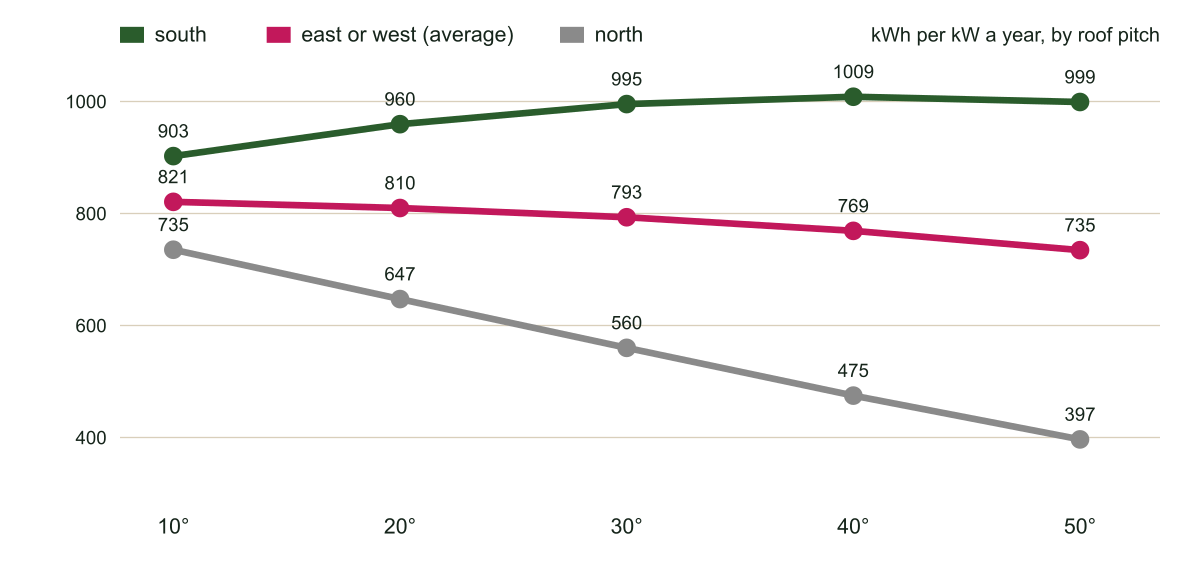
West roofs come out a little ahead of east roofs in these figures, by about one or two per cent in PVGIS's data for this spot. The difference is too small to choose a house by.
Why a shallow pitch helps
A south roof benefits from steepness because it tilts the panels towards a sun that is low in the southern sky. An east or west roof gains nothing from that: tilting it steeper only turns it further away from the midday sun. So a flatter east or west roof makes more. That suits Southport's bungalows and single-storey extensions, many of which have pitches well under 30 degrees.
Using both slopes
On a gable-ended house with clear slopes to the east and west, panels on both sides double the area. Each half makes its share at a different time of day, so the combined output is spread from early morning to evening, rather than peaking at midday. For a household that is out at work, more of the output arrives when someone is home.
Two directions need an inverter that can handle them: one with two separate inputs, or optimisers or microinverters on each panel. Ask how the quote handles this. The total size also affects the network notification; see from quote to switch-on.
Worked through: the example bungalow
Bungalows make up 6.8% of Sefton's homes on council tax records, fewer than the 9.1% across England and Wales, and where a bungalow's ridge runs north to south, its two long slopes face east and west. The roof planner's example bungalow has a west-facing gable slope 10 m long and 3.9 m from gutter to ridge at 30°. With the example panel and a 0.4 m margin it takes 10 panels, or 4.40 kW, which PVGIS expects to make about 3,536 kWh a year in central Southport. If the east slope is the same size and clear of shade, panels on both would make about 6,981 kWh, from a system of 8.80 kW. The example is a size chosen for illustration, not a measured house; put your own slopes into the planner.
Questions for a quote that uses two slopes
- What will each slope make on its own? A single total hides a weak slope.
- How are the two directions kept apart electrically: separate inverter inputs, or optimisers or microinverters on each panel?
- How was the inverter rating chosen against the total panel capacity, given that the two slopes reach their peaks at different times of day?
- Will the system be notified to SP Energy Networks after connection, or does its size mean the operator must approve it first?
When east or west is not enough
The numbers above assume an unshaded roof. A west slope that loses the late sun behind a neighbouring villa or a row of trees in the evening can fall well below them. The installer's shade assessment should show that; the roof planner lets you see the size of system each slope could take.
Read on
Sources for this page
Questions about east and west roofs
Are east-west solar panels worth it in Southport?
Often, yes. In central Southport an east or west roof at 30 degrees makes about 793 kWh a year per kW, around 79% of a south roof at 35 degrees, and spreads that output across the morning and evening, when many households use more.
Should I put panels on both the east and west slopes?
If both are clear of shade and you can afford it, using both doubles the roof area and gives a flatter daily output curve, which helps you use more of it at home. The inverter must suit two directions: two inputs, or optimisers or microinverters on each panel.
Is a low-pitched east-west roof better?
Slightly. PVGIS gives an east or west roof in Southport about 821 kWh per kW at 10 degrees and 769 at 40 degrees. A flatter panel faces more of the midday sky. Many bungalows and extensions here have low pitches.
Want a second opinion on your roof or a quote?
Tell us about the house, the roof or the quote, with your Southport postcode. The message goes to SEO-DONS LTD, the company that publishes this independent guide, and we answer by email. It costs nothing and commits you to nothing.
What happens next
- Fill in the form. A full postcode tells us which part of Southport, and which rules, apply.
- We read what you sent and reply by email with the figures and sources that fit your house.
- What you do next, and which firm you use, is your decision alone.